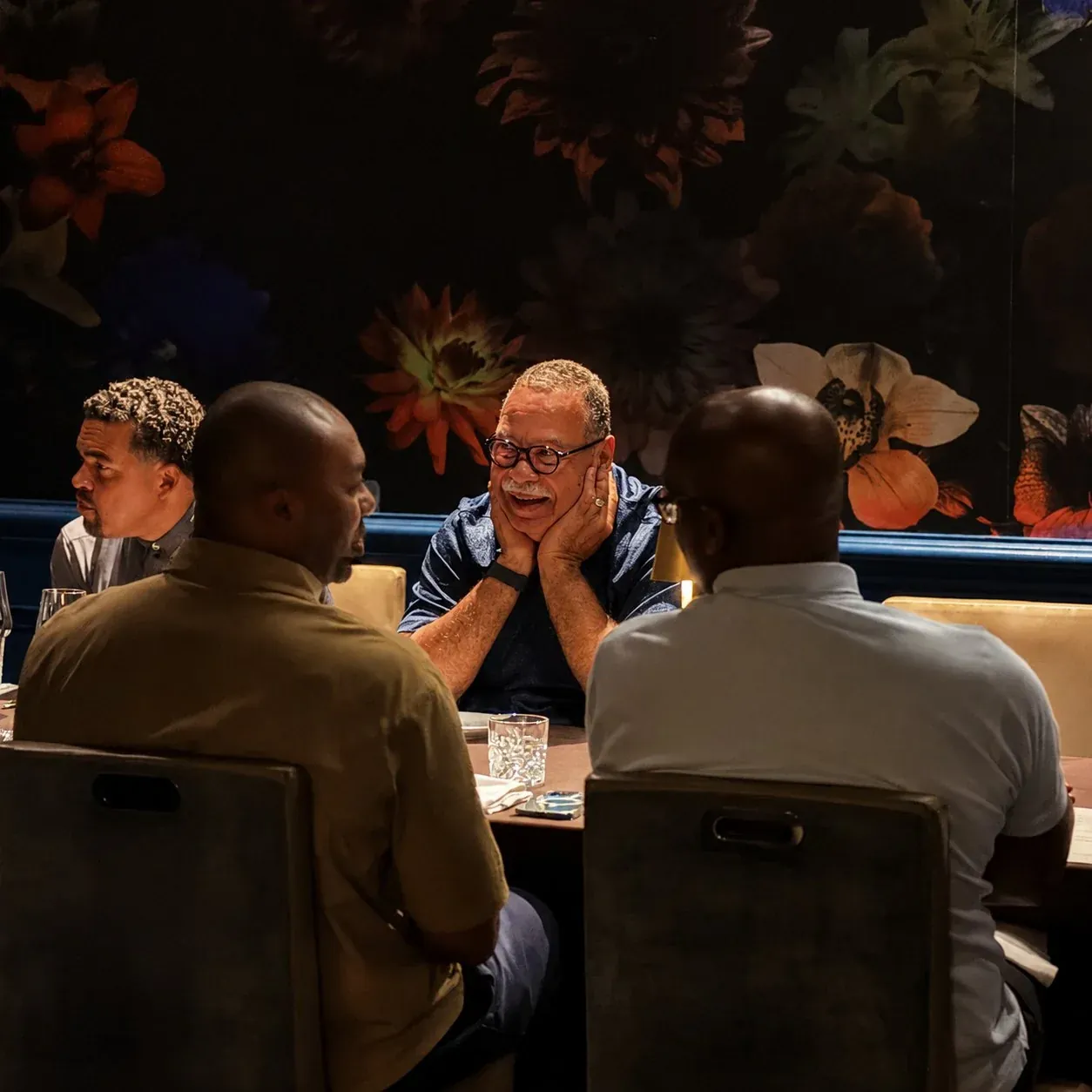
Practice.
At THE TABLE you practice speaking honor over people. In R Groups you practice naming what's really going on. Those are the same skills a marriage and a family run on.
Why it matters
Not your job or your schedule. What's really weighing on you right now. For a lot of people, the honest answer is no one. And it shows up everywhere we live: with our friends, in our marriages, and with our kids.
Friends
3% → 15%
Men with no close friends, 1990 to 2021. Researchers call it a friendship recession. It hit men hardest, but it hit everyone. [1]
Men with six or more close friends: 55% → 27% [1]
Women with six or more close friends: 41% → 24% [1]
Most of us have people we like. Fewer have people who know us.
Close friend: 200+ hours
The center is the one that's disappearing. Jeffrey Hall, University of Kansas [4]
Many of us don't just have fewer friends. We share less with the ones we have.
Shared personal feelings or problems with a friend [3]
Men30%
Women48%
So the weight goes one of two places: carried alone, or handed to one person.
Marriage
Leaning on your spouse is a good thing. Leaning only on your spouse is a lot for one person to carry.
85%
of married men, and 72% of married women, say their spouse is the first person they turn to with a personal problem. [2]
5 years.
In a study of married couples, husbands and wives with more, or closer, friends to confide in had stronger marriages five years later. [5]
Friends don't compete with a marriage. They help hold it up.
Parenting
Parents are surrounded by people all day, and many still feel alone.
66%
of parents say the demands of parenting leave them feeling isolated and lonely, and 38% feel they have no one to support them as a parent. [6]
48%
of parents say most days their stress is completely overwhelming, compared with 26% of other adults. [7]
Kids are watching.
Research has found the quality of parents' friendships is linked to the quality of their children's friendships. [8]
"If we sat down for a few hours and talked about what's really weighing on us, something would change. If someone asked you later, 'How are you doing?', you'd know: Mitch could answer that for me, and get it right."
Mitch Smith, Co-Founder
At home
Friends matter. But most of us want the best possible relationship with our spouse and our kids. Here's how what happens with friends shows up at home.
At THE TABLE you practice speaking honor over people. In R Groups you practice naming what's really going on. Those are the same skills a marriage and a family run on.
When a few people can answer for you, your spouse isn't carrying everything. You come home lighter and more present.
Children learn what friendship looks like from yours: honest conversations, showing up, making things right.
A weekly group builds the same habit as a weekly date night, a one-on-one with each kid, or asking "What do you need?" at dinner.
Why it happens
200+
hours to build a close friendship [4]
6 months
before closeness starts to fade without time together [9]
Weekly
time together is what keeps an inner circle close [9]
What it costs
29%
higher risk of dying early with social isolation, says the U.S. Surgeon General. [10]
85 years
of Harvard research: relationships were the best predictor of a happy, healthy life. [11]
Where BBR comes in
THE TABLE. One evening with people you trust.
THE FIRE. Meet the wider circle.
R Groups. Where you get known.
about 85 hours
a year with the same people. That's how friends become close friends.
Better friends. Stronger marriages. Kids who see what it looks like.